 The lipstick head in tuxedo symbolises female and coloured skin people as leaders. The World map falling off the edge represents the condition of our Earth that is not going to become positive. Crowd of hands say about people who seem to be helping to improve the world situations while the two hands that are trying to gap the map represents people who are really helping but it is not enough to make the condition better.Characters and letters of languages forming the map implies about globalisation and also mixed-culture. Cracks in individual letters expresses about local unrest. Heads at the bottom suggests about people to choose to ignore about what is going on in the World and see the world falling off without any feeling and a head up says about the percentage of the world population that seem to care. Grey background at the top expresses about the past that we are full of regret of our actions to the world.
20110822
The lipstick head in tuxedo symbolises female and coloured skin people as leaders. The World map falling off the edge represents the condition of our Earth that is not going to become positive. Crowd of hands say about people who seem to be helping to improve the world situations while the two hands that are trying to gap the map represents people who are really helping but it is not enough to make the condition better.Characters and letters of languages forming the map implies about globalisation and also mixed-culture. Cracks in individual letters expresses about local unrest. Heads at the bottom suggests about people to choose to ignore about what is going on in the World and see the world falling off without any feeling and a head up says about the percentage of the world population that seem to care. Grey background at the top expresses about the past that we are full of regret of our actions to the world.

20110821
Jun Collage

what seem to be a very big problem for us now is a continually growing of human population and in there future, there wouldn't be enough natural resources for all of us. There are 7billion people all around the world who share and use natural resources together. In the year 2010-2011, global production is expected to be not enough for global consumption. Soon enough, people will have to pay more for natural resources and might fight for it in the future. WIthout knowing, while people are reaching for natural resources, they are also creating trash and pollution to the environment. So, they are reaching for both resources and pollution.
20110820
20110819
Deep Ecology Summary by Plug
With too many global problems occurring around our world, all of the crisis are recognized by people as entirely different issues. But the more we learned about the problems, the fact that they are interconnected and somehow are influencing one another is undeniable. The new way of perception, or the new paradigm suggests the idea of the existed "links" which connect between everything in the world. For example, poverty is the consequence of the raising of human population, and more. It's crucial for us to have a radical change in our perception and also our way of questioning the world.
We as well as scientist, philosophy determine science the rules of reality and thus cannot be changed. The change of Physics laws in Newton era gave birth to many new reality and thus challenged the fact. We have to accept the new way of seeing and paradigm to see the new possibility to all solutions.
The new paradigm includes the terms holistic and ecological. Holistic worldview places human above all elements in the environment, shortly, human centered. The ecological worldview appreciates all values in the environmental at the same level, perceiving human as one of its network.
Ecofeminism states the dominated condition not only that of the women, taken as lower position than men, but also that of every class, and society. The new way of seeing suggests to reconsider the old organization formed by the leaders with old perception.The ideal society in which everybody have the equal rights and opportunity can be achieved by the shifting our paradigm.
Prompt's collage remake
Prompt's Project Zero : Remake
Title : Sorry...

This collage is under the concept that no matter what happens in the political issues [all those fights between countries, people] that we received into our mind; the one who really lost, is this country itself.
Prompt Udomdech 5334766425
Deep Ecology Summary - Mark
This article presents a new branch of study called Deep Ecology. According to Dr. Capra, deep ecology is different from shallow ecology because it does not separate humans or anything else from the nature environment; “It sees the world not as a collection of isolated objects, but as a network of phenomena that are fundamentally interconnected and interdependent.” Capra suggests that perhaps the atom is not only composed of electrical particles but also a “soul” since it “cannot be weighted or measured in accepted ways.” Later, scientists such as Albert Einstein, Max Planck, Werner Heisenberg, and more help to overcome the assumption against the revolutionary concepts that resulted in “The Paradigm Shift” in Capra’s term. The overly intelligence words scientists use to explain the revolutionary concepts are later made understandable to common man; which has impacted everyone through the increasing environmental practices of recycling and conservation. Furthermore, Capra also links diverse elements in a complex world through the idea called “web of life”; he notes that less advanced brothers are helped in their evolutionary journeys by the higher evolved brother although the help may not be noticed. This supports the ancient saying that “Nature unaided fails.” It points out the ways like good teachers do and then it’s up to the learners to make the progress. In this model of the new reality, women are also brought into attention. Women have the kind of power that can keep peace and harmony within a large society. They tend to emphasize the “heart doctrine” and men as the “head doctrine.” In the end, the definition of “life” remains indefinable because it always changes and progresses.
20110818
Deep Ecology Summary - Pimmy
For centuries, man has seen the world around him as something that should be controlled. A person is defined by the power he exerts over the society he lives in and by how much wealth he can accumulate. But, with an ever growing population and the world moving towards becoming a single community, rather than separating states, this model needs to be re-examined. Human existence needs to be viewed as working as part of a finely balanced system, rather than a fight to control it.
Most people view the world as an individual living within an individual society. Our actions are judged in, not fully define their impact on the world around us, and ‘success’ is failure to accept that all life is interrelated and interdependent. These traditional views are no longer sustainable.
Since the time of Newton, Science has been seen as a way of understanding, ordering and remoulding our world. We celebrate the sciences to suit our demands. Sciences are seen as logical and ‘right’. In current state, they may lead to the downfall of all species that populate this Earth.
Deep ecology seeks to work in harmony with the world around us and create a system that is sustainable in a world which is becoming more singular. It involves the coming together of various social, economic and psychological aspects. It requires a shift in how we view our own lives, our aspirations and the way that the world as a whole is perceived.
For life on this planet to be sustained, we need to reject many of our current values and see each individual working as part of a caring system where selflessness is the only way to secure the existence and well-being of the individual. We need to create a world where destruction and domination need to be replaced by care and conservation.
Pimmy
bridges
Some references to begin with:
- the Rope Bridge by Gordon Matta-Clark (even if you cannot find this particular project, it is more than crucial and delightful to discover his work!)
- Scarpa's bridges in Venice
- Gustave Eiffel bridges (Porto for a realized example)
- the bridge of no-return between north and south Corea
- the Bridge Problem / 7 Bridges of Konigsberg, resolved by Euler
- Loophole by R&Sie
- Moses...
- diverse projects to connect Great Britain to the Continent (before Eurostar)
- the rotating bridges of Chicago (and other)
- Sergio Musmeci's fantastic structural work (also Pier Luigi Nervi)
- Chenonceau Bridge-Castle
- Millennium Bridge in front of the Tate Modern in London
- Tacoma Narrows bridge (and other mechanical resonance phenomena stories)
- Lowentor Pedestrian bridge
- etc.
See you all on Tuesday!
Don't forget to post your summaries before 1pm tomorrow.
- the Rope Bridge by Gordon Matta-Clark (even if you cannot find this particular project, it is more than crucial and delightful to discover his work!)
- Scarpa's bridges in Venice
- Gustave Eiffel bridges (Porto for a realized example)
- the bridge of no-return between north and south Corea
- the Bridge Problem / 7 Bridges of Konigsberg, resolved by Euler
- Loophole by R&Sie
- Moses...
- diverse projects to connect Great Britain to the Continent (before Eurostar)
- the rotating bridges of Chicago (and other)
- Sergio Musmeci's fantastic structural work (also Pier Luigi Nervi)
- Chenonceau Bridge-Castle
- Millennium Bridge in front of the Tate Modern in London
- Tacoma Narrows bridge (and other mechanical resonance phenomena stories)
- Lowentor Pedestrian bridge
- etc.
See you all on Tuesday!
Don't forget to post your summaries before 1pm tomorrow.
Deep Ecology Summary - DREAM
In this current time, most people are buying the wrong, outdated idea of the world. They have failed to realise that major problems the world is facing are systemic problems, interconnected and interdependent , and are fragments of one intergrated crisis in which cannot be understood on its own. This will not be solve until a paradigm shift into an ‘ecological paradigm’ has occurs and people undergoes an utter change in thier perception, thinking and value.
Ecological Awareness is an acknowledgement of the earth-centred values rather than just a human-centred values. This can be break down into ‘shalow’ ecology which excludes humans from the narural environment and ‘deep’ ecology which recognises value of all living beings and views everything as one unified whole.
Additionally, social ecology and ecofeminism is also an important philosophical schools of ecology that addresses important aspects of the ecological paradigm. Social ecology is the acknowledgement of cultural characteristics and that patterns of social and economics structures along with their technologies are rooted in the ‘dominator system’ of social organisation, whereas ecofeminism views the men domination over woman as a prototype of all domination and is deliquently adopted in various hierarchical forms.
Thus, the shift of paradigms requires not only our changes in thinking but also values in a healthy and dynamically balanced way, it is less self-beneficial and therefore founded difficult by most people. Hence why its viewed most urgent to introduce an ‘ecoethical ethics’, a new systems of ethics related to the understanding of deep ecology that every lifes are connected, to the world especially to the science field. Unless the understanding of ecoethical ethics and a deep ecology paradigm shift has occurs, humans perception of the world can becomes life-threatening to all living beings on this planet in the end.
Deep Ecology Summary - Jun
Understanding the reality of a new world is what the author wants to imply to our modern society. Understanding the new world is to be able to accept the theory of seeing the world in a whole cannot which cannot be separated. People have studied about problems in this world and start to realize that they cannot look at the world as in isolated parts. The world we are living in is all connected. However, their politic leaders do not care about problems and fear to receive any fundamental changes from the new world because not only their thinking that has to be changed, but also their values. If changes were able to do so, we might be able to achieve a ‘sustainable’ world. So, a new paradigm or paradigm shift has been brought up to urge people to change their way of thinking and be able to accept any radical changes. The new paradigm can be seen as in two views, holistic view and ecological view. Holistic view sees the function as a whole and acknowledges all parts of the function. And for ecological view, author also introduces two more ways, deep ecology as a way to look at the world wholly and see humans as part of nature, and shallow ecology as humans being a center of all living beings. If people start to realize the importance of deep ecology, they would probably accept the radical changes and the equality of humans and nature.
Deep Ecology Summary - Pae
In this new century, there are several global problems, interconnected to each other, such as an overpopulated in world population, poverty, or extinction of animals and plants species. Those problems may be considered as a whole different causes and resolutions, but in fact, caused by mainly a problem which we called, a crisis of perception. Approximately fifty years, physicists and philosophers have been debated about this change in paradigm where, according to Thomas Kuhn, changes in paradigm occur in discontinuous and revolutionary breaks which so-called paradigm shifts
Not only in physics field where paradigm shifts occurred in twenty-five years ago, whereas they can be found in a much larger arena throughout the world; which is now to be concerned as a cultural transformations rather than physics itself. What is happening now is that the revolution of paradigm, for instance the view of human body as a machine or the achievement in technology growth, has shaped up our society for over decades and as well as influenced the rest of the world.
The new paradigm, generally, can be called either holistic or ecological worldview. However, ecological seems to be more applicable to the term since ecological sees things within how it functioned, as same as holistic, and addition to the effect on communities and environment. In deep ecology, according to Arne Naess, the Norwegian philosophers, it prioritizes human as same as other existence. Another characteristic is to question more, which considered as another kind of paradigm shifts as well. Within ecology schools, social ecology and ecofeminism schools seem to be interesting as well since social ecology does much more on cultural characteristic and patterns while ecofeminism concerns more on the context of patriarchy.
Moreover, even though expanding our perception is very important, however, having values is another necessarily aspect as well. In the past patriarchy in society plays a major role that gives power, self-assertive, and prioritizes men as an upper class of women. However, according to new paradigm, it shifts social organization to networks.
When comes to daily life, deep ecological ethics is needed especially in sciences which what scientists do today is not life-preserving but life-destroying. Yesterday we might have separated facts from our values, whereas today’s society has corresponded perception and behavior as a psychological connection.
Deep Eco's summarize
Congratulation to myself...i can finally post on this thing.....
Deep Ecology's Summarize
What the writer wrote and stated in this book is about deep ecology, the new paradigm. The writer was trying to convey that nowadays environmental concerns have become a very important topic. He stated that we are now facing the whole global problems that are harming the world itself and all the lives on it, and that it may soon become unalterable. The writer did suggest that some of the solution might be very simple, but yet no one, even the higher up see how different problems are interrelated, and yet, they refused to understand. The writer’s main interest has been about how concept changes over time, and so he suggest about Kuhn’s idea which the writer later called it “Paradigm Shifts”. This paradigm sees the world as an integrated whole rather than a dissociated collection of parts with the terms “holistic” and “ecological” where holistic is less appropriate then one other. Ecological can be separate into twos, one is shallow and the other is deep; where deep ecological awareness seems to provide the ideal philosophical and spiritual basis for an ecological lifestyle and for environmental activism. The writer mention that we need a power to expand not only our perception and thought, but also our values in order to creates a shift of paradigms. Simply putting things together from the writer’s opinion; we need to start thinking mainly not for our self but to the surrounding that we were surrounded by to create a shift in our mind where problems can be solve.
Prompt Udomdech 5334766425
Deep Ecology's Summarize
What the writer wrote and stated in this book is about deep ecology, the new paradigm. The writer was trying to convey that nowadays environmental concerns have become a very important topic. He stated that we are now facing the whole global problems that are harming the world itself and all the lives on it, and that it may soon become unalterable. The writer did suggest that some of the solution might be very simple, but yet no one, even the higher up see how different problems are interrelated, and yet, they refused to understand. The writer’s main interest has been about how concept changes over time, and so he suggest about Kuhn’s idea which the writer later called it “Paradigm Shifts”. This paradigm sees the world as an integrated whole rather than a dissociated collection of parts with the terms “holistic” and “ecological” where holistic is less appropriate then one other. Ecological can be separate into twos, one is shallow and the other is deep; where deep ecological awareness seems to provide the ideal philosophical and spiritual basis for an ecological lifestyle and for environmental activism. The writer mention that we need a power to expand not only our perception and thought, but also our values in order to creates a shift of paradigms. Simply putting things together from the writer’s opinion; we need to start thinking mainly not for our self but to the surrounding that we were surrounded by to create a shift in our mind where problems can be solve.
Prompt Udomdech 5334766425
Pimmy's Project Zero, remake

Nowadays people whom living in city consume some products that they desire rather than necessity. From our closest thing, food. I'm using the illustrated work of Andy Council having red devil's hands as fast food side, easily demanding attention from people. At the same time these people, trying to grab the fast food, are stepping on the painting of Giuseppe Arcimboldo. The painting called 'Vertumnus', the god of seasons and abundance, representing healthy side. The green living tress turning into red dead trees below are representing your life, your body how is it going to be if you were at the side you've chosen. And all of these is happening on the city we're living, full of neon signs and advertisements everywhere, and almost every time.
Thank you
Pimmy
20110817
Deep Ecology Summary - A
Deep Ecology is about how our new scientific understanding of life is based on a new perception of reality. The problems in the world today are interrelated. They can't be understood separately. Together, it's a crisis of perception which can be solved by a radical shift in our thinking. But somehow higher authorities seem to have not dealt with these issues with proper solutions. Accordingly, a paradigm shift, not only within science but in a larger social realm, is needed to change how people view and shape their modern reality. The new paradigm can be defined as deep ecology which is comprised of holistic and ecological worldview. Deep ecology sees the world as a network of phenomena that is interconnected and interdependent and is concerned with the perspective of our relationships to others. We need to shift not only our ways of thinking but also of our values which are essential aspects of life. Moreover, the new paradigm longs for a kind of power that is influential to one another. The idea of hierarchies need to be replaced with networks in order to form a stronger foundation of our modern way of living. However, the notion of the old scientific paradigm hasn't been forgotten. It has along the way helped carry out a shift from physics to the life sciences as it is nowadays.
Noc's summary for Deep Ecology
The author of Deep Ecology is trying to convey us with the idea that everything on Earth is related. The global problems that we are facing are interconnected - they are the causes of another problem and the main cause for all these problems is the matter of perception in which our leaders, or people who have the authority to decide what to happen, are not up to date and foresee enough to deal with the issues. Therefore, the shift in paradigm is in need as it will change the way people think and live. The new paradigm can be seen as a deep ecology in which human is seen as a part of the whole natural system and not above it. The idea of the old paradigm is more likely self-centered rather than earth-centered as the new one would be. The shift in paradigm also requires the shift in values to balance with the thinking to bring out the good outcomes as they are interconnected ecologically. The idea of gaining power and domination over the others in the old paradigm should be replaced with thought of sharing and influencing the other to a better position together. Basically, we have to apply the ecological concept of the nature in our living that we are all interconnected and interdependent and that is the values to enable us to shift to the new paradigm.
COLLAGE ON THE BLOG
Congratulations for today's presentation!
Please, all, post your collage on the blog (you can improve it according to the comments made today).
It was a great afternoon, filled with very promising work.
Please, all, post your collage on the blog (you can improve it according to the comments made today).
It was a great afternoon, filled with very promising work.
20110816
20110814
Prompt's Project Zero
Title " WHY NOW?"

This collage with painting geopolitics work can be view from 2 ways, first way is the image above which is telling one story, other way of viewing which will tell the real meaning will be presented [along with the details of the first story and the whole concept] orally on the presentation day.
Prompt Udomdech
20110813
IMPORTANT - request for fridays 19 and 26
Dears,
As i may have 2 engagements,
I would like to ask you if it is possible for all of you to pre-pone our studio classes of Friday 19th and 26th of August PM to Thursday 18th and 25th or, possibly Friday morning.
Please let me know.
Thank you!
As i may have 2 engagements,
I would like to ask you if it is possible for all of you to pre-pone our studio classes of Friday 19th and 26th of August PM to Thursday 18th and 25th or, possibly Friday morning.
Please let me know.
Thank you!
Answer to Mark
Death itself can be an angle through which to look at the world and its unfolding events.
You do not have to deal with all the subjects mentioned.
And yes of course you can use artist's works in your collage - ANYTHING!
20110812
Noc's Project Zero
Dear Aj.Camillee ,
So after I've tried to understand the idea of the project, I have come up with some ideas which I would like to express in my collage. My collage will be consisted of a few issues in the present world and apart from that I'll also include their outcomes which some of them are interlinked to another issue, like for example, we now have coloured skin and female leaders which infer that we are not sexist or racist as before and so it brings about the equality in some societies,or globalisation which bring people across the world closer but it also comes with the mixed cultures and the Western trends in the East which affected the Eastern-like traditions. I am still not so sure of how I'll express them on my collage to make them all linked and able to imply more meanings beyond what's obvious on the collage. I'm still researching and trying to understand those artists' works that are used as the example. For Jacques Henri Lartique's works, some his works are photographs which can give us the feeling of speed and movements and so his work is used as an example to show us how we can display the fast movement on our collage? Did I understand it correctly? Personally, I like the F-111 work by James Rosenquist which he could express so much meanings behind what he shows on the collage which do not seem to make any sense, but the detail is so much and I will need to time to understand. Please do advice me. Thank you.
Noc
20110810
answer to A
I understand the concern you might have for those children in Africa and the hopeless situation they are in.
However do not embark on a pure denunciation of a phenomenon too great to be apprehended so quickly (besides it is not the point of this exercise).
What would be interesting rather is to observe and manipulate into a collage how those informations (this particular one, and maybe other terrible facts which are projected onto us regularly although we are physically unable to reach or feel them) are reaching us.
What are the media involved, how are we directly addressed, what is used to touch us and touch us in what ways, what are the conditions of our incapacity to act or react, etc.
If you are willing to pursue in this direction, i recommend a great documentary film-maker, Adam Curtis.
He is really skilled at digging into archives for all political and societal factors secretly woven in public phenomenon.
welcome to our blog!
Dear all,
This our platform. Please post regularly - your work - your comments - the references you find - your questions etc.
20110511
last meeting - dinner?
Hello all
First of all my sincere congratulations for your final review!
You have managed to produce a lot of work in those final weeks, and i know you had a lot to do!!
I hope the ones who were late have learnt the lesson once and for all: you will get F for all presentation grades.
And it will seriously impair your grade for this semester.... it's sad, is this really the only way to get you to be on time??!
I thought that our last Y2 meeting (to give you feedback and recommendations) could be a lunch or dinner...
We could meet next week -say Tuesday evening after SuperCrit? - we will have more time once all BACC events are over and the exhibition up.
What do you think?
And i expect to see you all on Saturday in order to set up our Y2 exhibition, meeting at 1pm at BACC.
First of all my sincere congratulations for your final review!
You have managed to produce a lot of work in those final weeks, and i know you had a lot to do!!
I hope the ones who were late have learnt the lesson once and for all: you will get F for all presentation grades.
And it will seriously impair your grade for this semester.... it's sad, is this really the only way to get you to be on time??!
We could meet next week -say Tuesday evening after SuperCrit? - we will have more time once all BACC events are over and the exhibition up.
What do you think?
And i expect to see you all on Saturday in order to set up our Y2 exhibition, meeting at 1pm at BACC.


20110507
SITE MODEL + be well prepared!
Dears,
We need to be sure that the site model will be with us Tuesday morning at BACC.
Can someone (or 2 or 3 of you) take this responsibility and move it (by car or taxi) in the morning?
Thank you in advance!
Prepare your oral presentation well and get some sleep before the review.
You should aim to have everything ready by Monday noon - and spend the afternoon and evening rehearsing and resting.
Best wishes to all.
You ALL should be there with EVERYTHING you intend to present at 10 am sharp.
NO PRINTING DURING THE DAY, NOR LATE ARRIVAL.
After 10.15, your grade will be drastically reduced and you might not be allowed to present.
We need to be sure that the site model will be with us Tuesday morning at BACC.
Can someone (or 2 or 3 of you) take this responsibility and move it (by car or taxi) in the morning?
Thank you in advance!
Prepare your oral presentation well and get some sleep before the review.
You should aim to have everything ready by Monday noon - and spend the afternoon and evening rehearsing and resting.
Best wishes to all.
You ALL should be there with EVERYTHING you intend to present at 10 am sharp.
NO PRINTING DURING THE DAY, NOR LATE ARRIVAL.
After 10.15, your grade will be drastically reduced and you might not be allowed to present.
20110506
Shop HOuse Process

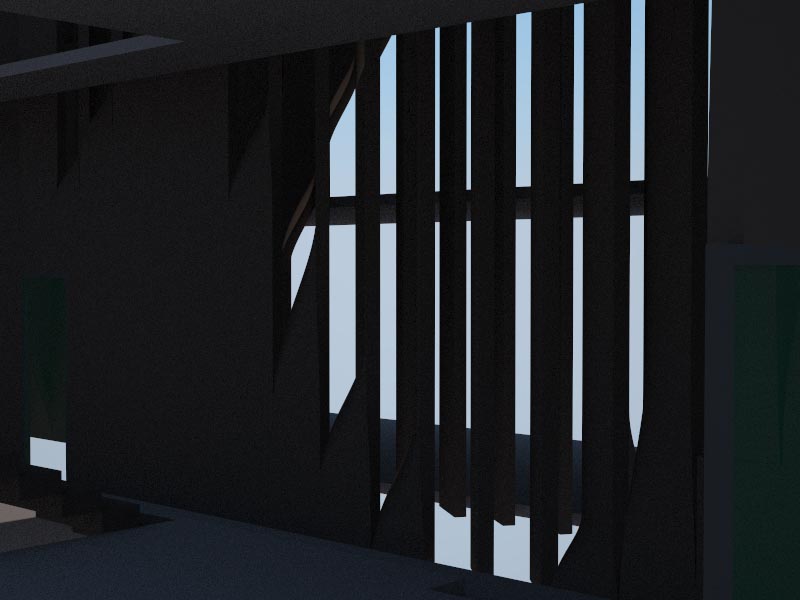


as shown in the rendering, the idea of the facade, from the movie,
to hiding their relationship but what they really want to be is not to be hide it
for the interior, at first i considering not to put any wall inside the house, because the idea of the openness in the house, but for reality , people always need their privacy, so now i thinking about the tranparent wall and the curtain behind
the twisting facade has different angle lead to the different viewpoints between both shoophouse
20110503
Hey guys,
Below is the summary of my interests through out this semester. It kind of explains what inform and influence my decision making and design process and also talks about my conceptual framework for my design for the Shophouse.
Please see Aj Camillee's post about next tutorial session below my post. ( My apology to over post your post kub aj. camillee)
Enjoy,
TOWRDS THE NEW BEGINNING


At an attempt to apply my point of view in architecture ( My manifesto ) to my own work I'll tell you how the knowledge I developed through out the class has been applied to inform my decision making and design process for the final studio design project – The Shophouse for Film critics. Although the time scale is only about 4 week longs but to me every assignments prior to the design phrase is an equivalent to the Grand Tour where you learn and develop architectural vocabulary through your hard work and most importantly your curiosity. At the opening of the semester we chose one master architect and one of their domestic project to be closely examined for me I chose Rem Koolhaas and his house design – Villa Bordeaux. This phrase is called “ Learning from the Master” which I think it's similar to the learning of history that most of the famous architects did before they create their own manifesto and ultimately their own architecture.
Nonetheless, the Villa Bordeaux represents a kind of Apostate itself to the modernism by Koolhaas's use of iconoclastic which focuses on the destruction of modernist values and icons. The example of this would be the overturning of the modernists aspiration for truth and transparency where in the case of Koolhaas he attempted to play with people perception and have people guess what is the main primary structure of the house – people often guess that it was the big rounded column cladded in reflective material but in fact it's the opposite – the smallest structure turns to be the most important of all – thetensile steel rod anchoring the weight of the house down to the ground. The breaking of symmetry through the displacement the structural members seem to be going against the modernist strict adherence to order and symmetry. Because this apostate break way from the orthodox modern architecture of static – meant to be forever – attributes and introduce more dynamics into the architecture. I also in favor for Koolhaas's treatment of the three totally different facade which correspond to the programatic requirement of the interior – where the ground floor being semi private space so the facade makes use of semi translucent glass and in the 2ndfloor where it's programed to be use mostly for living room the facade open up totally and the 3rd floor where the programa is the most intimate such as bedroom the facade change its materiality from glass to concrete with small portholes. I praise him for the customization and not blindly strict with the rules that did not allow for flexibility and specificity.


We have seen a tremendous influence of art on architecture since from the cubism to de stilj to deconstructionism. All these art movements were presented something radically interesting for many architects and it had been translated into architecture as well as furniture design. Art as the means of expression. But architecture of the present and particularly at my age where we are surrounded by mass media culture we tend to favor Film rather than Art. The film medium become much more relatable to the majority of the population as opposed to art where it's required certain knowledge in order to appreciate it. Therefore, as film medium is as much closely associate with architecture as to art we have studied the filmic medium and try to deconstruct it to find our own vocabulary and conceptual framework to design the shophouse for the client who is also the film lover. At the beginning of the discussion I talked about how I stand for the power of an institution it's because of this reason where you are being pushed to think out of the box and find your inspiration from the source that unfamiliar to you. This will not only provokes new thoughts and ideas but it will open you up to the unknown territory where the process of how to derive the concept is equally important as the final product itself. The analysis of my film – Wong Karwai – In the mood for love – is based methodology of unified organizational clarity of which I want to observe the relationship of the two married people and their immediate settings, therefore I divided my scenario into different settings and monitor the changing in behavior and intimacy and also how the camera work changes. This unified organizational clarify of what I want to archive through the breaking down of the film sequence into list of setting in combination with the emergence of visual complexity of each interaction within the different settings as the film narrative developed provided me with an interesting conceptual framework of how and what determine the change in people behavior in relation to the underlying narrative of the story.

Moving on to the next phrase where we conduct a site analysis of the house's immediate surrounding by using filmic techniques in documenting these site specific informations such as recording and film making. I started to discussed my take on the site analysis as similarly to what Zaha hadid did with her architecture. I want to document the urban forces interm of circulation between different users and how they chose their appropriate route to get into or around the neighborhood. I perceived the site as having based on the grid line type of planning where there are these small alleys cutting in between the houses. Hence, I want to use the filmic medium or video recording to document each of the alleys for 10 minutes each and then after that decomstruct the film as I did earlier during the fim analysis phrase and come to the conclusion by quantify the frequency of users and the direction which they look – most turn left or right – then I went on to continue documenting the next part of the journey. For example, If the first alley I decided to video recording has 10 people walk pass by and 7 of them turn right at the end of the alley then I can develop a kind of if.. then scenario that if 10 people walk pass by and 7 of them turn right then the majority of the people who walk pass this alley will turn right. Another thing I notice from my site analysis is the basic organisation of the house in relation to the alley way and how different orientation weather you in front of the house or in the alley between the walls of the two adjacent houses or the back of house will give different experience of space and it also dictate different kind program because you basically enter from the public realm which is the front of the house to the transitional space which is semi private and finally you enter the most intimate surrounding which is the back of house. I think it would be totally different kind of approach and different result if this assignment did not required you to look at the site from the filmic aspect perhaps all of us would use the same old traditional way of google earth map and large scale exploration of the site rather than human scale based experience. Therefore, this experience taught me of how to be inclusive by combining many sources of knowledge to arrive at something radically new that you never thing of doing before because of the feeling that breaking the norm would equal to failure. Therefore, I praise for the juxtaposition and exploration of uncertainties that have leave some rooms for creativity and invention.
For the last phrase we have to come up with a strong conceptual framework by drawing connections from the previous studies including learning from the master, film analysis and site analysis and conclude the unified conceptual framework to approach the design of the shophouse. I begin my conclusion of conceptual framework by asking myself what I want to archive and then I define my own intention toward the design of the house. My intention is to create a kind of crossover between users such that of guests, owners, and servants. This interwoven of interactions between multiple users will be the conceptual framework of my shophouse design. After I stated clearly my intention of how I would go about designing the house, I will use it as an underlying guidance and try to find means that would answer my intention. After stated clearly the big idea, I shifted my attention toward drawing connections between the previous studies. What I got from The learning from the master project is that the way Koolhaas's customized each space to suit with appropriate programatic requirement. I like his approach that the overal project look unified but when examined closely into each components the house was actually tailored down to each program and also circulation where there are three separate circulation element for each of the users. As for the film analysis, I want to extract the most interesting concept out of this phrase because it will determine how your house will be conceptually different than the others people who's doing the same movie as you. I chose to work with the essence of the film where its main characters involved in the secrete relationship and they often have secrete interaction that is very implicit such as walking pass each other in a tight space which also respond to my intention of generating a cross over which then can be related to the concept of multiple users having crossover of interactions. As for the Site Analysis, I extract the organisation of the shophouse where it's situated in an orientation of front of house – public, side alley – semi private and back of house – private. This organisation will help me determine to allocate each program in a correct hierarchy so that it will be correspond to the way people move from public to semi private and private and vise versa. This pragmatic organisation will only be applied to the first floor of the shophouse only since it had intimate relationship to the ground and the surrounding.
From The above conclusion of conceptual framework, I then designed my house based on the basic principles of parametric design started by creating the desire scenarios ( to generate cross over between the multiple users) . I accomplish this desire by drawing from two connections, one from film and another one from the specificity of how the client, guests and servant will use the program. The first approach aim at the crossover interactions through the acts of watching. I decided to came up with the modular units because one of the challenge of this house is to design within a restricted amount of space there fore I think modular units can be assembled in many different way and it can be efficient interm of how it takes up the space because eventually every units will fit perfectly together without leaving useless negative space. From this thinking in term of modular units and I developed three scenarios which related to the film. The first scenarior is the view from the actors point of view, so basically this module will be dedicated to the house owners programs such as bedroom, bathroom and screening room where the space required certain amount of privacy. The second scenarior is the view from the camera : this view you are the camera looking into the actors which is basically the owners so this view is equivalent to the view of the gusts or the servants. The third scenarior is the view from the audience watching te film : so this view depict the view of the guests watching over everyone in the house. As to archive the same level of customization and specificity as in Koolhaas's Villa Bordeaux and other architects I mentioned, each of the three types of module accommodates the three different types of scenarior and different programs will be customized to make suitable adjustment to emphasis more strongly the concept of the three scenariors. Hence, The first scenarior where you view from the owner point of view this space require privacy so it will employs the use of framing within framing where the wall of the module will be solid and also with a door. For the second scenarior where you view the space from the servants or guest point of view where the space require not much privacy the glass panel will be use for all the 4 sides of the module and the solid door will be use so that the guest and the servant would respect the boundary created by this door. The last scenarior, where you view from the guest point of view all 4 sides of the module will be totally open with no panel and no door so it will tricker the comtinulity of space for the public realm. Also the form of the module comes in 3 shapes. The first one is for the first scenarior ( where you view from the owner point of view : more private ) the two walls of this module therefore leaning inwards to create a space that is more introverted. The second module for the second scenarior would be a normal rectangular since its pragmatic requirement is for semi private therefore the straight edge give the sense of neutral where the space is both private and public at the same time. The last module panels will be leaning outward creating that sense of welcoming and it wil triggers people to come closer to his slanted surface to watch over another space.
The overal design process of this house was trying to mimic the idea of parametric design where you consider many variables that can become influential to the decision making and the transformation of the existing typology such as the regular modular unit. You have seen how the starting module become manipulated and transformed by the consideration of different variables concerning the film, the site and the programatic requirement. The emphasis here is on the inclusive approach and the engagement in large scale subject matters from site to each of the requirement of each program. With this engagement in various scales it gives one design many values that can have multivalent meanings and not ended up read as flat and boring to that of deductive conclusion where many good opportunities have lost along the road of naive.
Bibliography
History and Theory of Architecture II course taught by Ajarn Taylor Lowe
Venturi, Robert. Complexity and Contradiction in Architecture. New York: Museum of Modern Art, 1977. Print.
Le, Corbusier, and Frederick Etchells. Towards a New Architecture,. London: Architectural,
1946. Print.
Wolfe, Tom. From Bauhaus to Our House. New York: Farrar Straus Giroux, 1981. Print.
Koolhaas, Rem, and Bruce Mau. S M L XL: OMA. S.l.: S.n., 1993. Print.
Sakamoto, Tomoko, and Albert Ferré. From Control to Design: Parametric/algorithmic Architecture. Barcelona: Actar-D, 2008. Print.
Balmond, Cecil, Jannuzzi Smith, and Christian Brensing. Informal. Munich: Prestel, 2002. Print.
Spuybroek, Lars. Research & Design: the Architecture of Variation. New York: Thames & Hudson, 2009. Print.

next crit?
Dears,
As we could not meet today - when will be the best time for you to have a last desk crit?
Friday afternoon / morning or Saturday?
Let me know - in the meantime we can have blog tutorials
As we could not meet today - when will be the best time for you to have a last desk crit?
Friday afternoon / morning or Saturday?
Let me know - in the meantime we can have blog tutorials
20110430
further ideas...


So after the tutorial, i came back to think about clearly defining what is public and private and like you said, i decided to change the screen room to be in the public building as well as the living room. What is left on the private building would be all the bedrooms and the bathrooms within them because if i move the bathroom to the public building, everything would be all cluttered in the public building as well as it does not make sense in terms of function for the owner of the house to have to walk to the other building to go to take a shower and then come back to their bedroom to dress up. Since i decided that the screen room for the camera obscura will be used as the camera obscura room and then the next sequence will be for the public to watch the film, i decided to move those film room to the second and the third floor in order for the public to interact more with the house. This will make it more interesting in terms of voyeurism since by this, the people who live in the house has the ability to spy on the public that intrudes their house as well rather than spying on themselves that obviously live in the house. For the first floor, they will see the image projected from the camera obscura. On the second floor, it is the film room for them to watch a scary film. the third floor would be for them to watch a comedy film. the storage room for films would be underground. By giving them different types of films to watch, the voyeurs can see the reaction of the public on those films when they do not know that they are being watched. The public would come in since those film rooms will allow the sound of the public out to the site to drag attention and give hints to people that they can actually come in. This matches how the public building is to show the behaviors of people as a public performance. So the screen room/ film room would be my public component.
Subscribe to:
Posts (Atom)